Moments ago at the opening keynote of NVIDIA GTC, Jensen Huang took the stage to outline NVIDIA’s latest innovations and its vision for the future of AI.
The presentation moved across the company’s technology stack, covering advances in AI infrastructure, software ecosystems, graphics, robotics and autonomous systems. One message was consistent throughout the keynote. Artificial intelligence is now becoming a core layer of modern computing infrastructure.
For organisations deploying AI today, the direction of travel is becoming clearer. Accelerated computing, highly specialised systems and tightly integrated software platforms are shaping the next generation of data centres.
Twenty years of CUDA and the foundations of modern AI
This year also marks an important milestone for NVIDIA. The company is celebrating the twentieth anniversary of CUDA, the programming platform that transformed GPUs from graphics processors into powerful engines for accelerated computing.
Since its launch, CUDA has grown into one of the most widely used computing platforms in the world. It now underpins applications across AI, scientific computing, healthcare, finance and manufacturing. Developers building these applications rely on NVIDIA’s growing CUDA X library ecosystem, which provides domain specific acceleration for a wide range of industries and research areas.
One of the most influential of these libraries has been cuDNN. By accelerating neural network training on GPUs, cuDNN helped trigger the modern deep learning boom and played a key role in enabling today’s generative AI models.
Together, CUDA and its associated libraries have created a powerful ecosystem that continues to expand. Developers build applications on CUDA, which drives demand for accelerated hardware and encourages further innovation across the platform. Two decades on, the impact of that ecosystem continues to shape the direction of the AI industry.
AI infrastructure enters a new era
Another key theme throughout the keynote was the changing role of the data centre. AI workloads are no longer confined to research labs or development environments. They are now running at global scale across enterprises, cloud providers and national infrastructure.
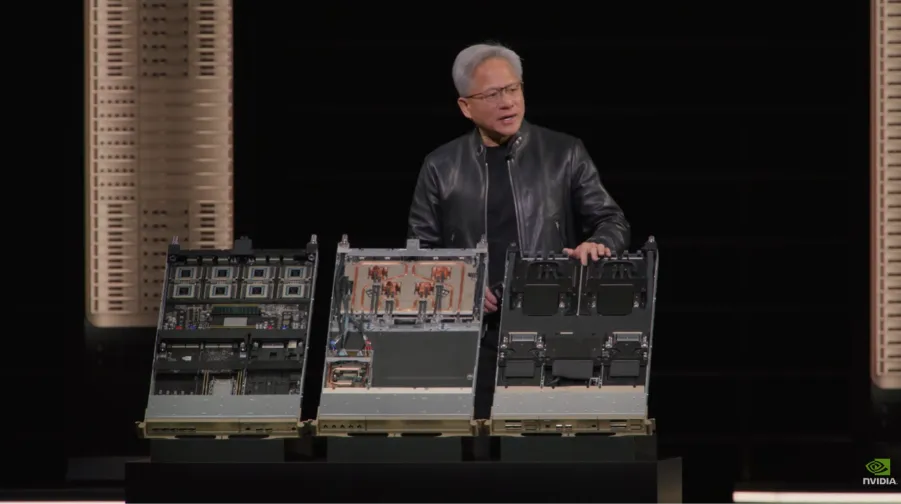
As a result, data centres are evolving into what NVIDIA describes as AI factories. Instead of primarily storing data, these environments are increasingly focused on running inference workloads and generating tokens from AI models.
Inference has become one of the most demanding challenges in modern computing. As models grow larger and more capable, organisations must deliver both high throughput and low latency simultaneously. Achieving that balance requires highly specialised systems designed specifically for AI workloads.
This shift highlights why accelerated computing is becoming so important. Traditional scaling methods are no longer sufficient for the demands of modern AI systems, and organisations are increasingly adopting new architectures designed to handle these workloads efficiently.
The next generation of AI systems
One of the most significant technology announcements during the keynote centred on the NVIDIA Vera Rubin NVL72 platform.
Designed for large scale AI training and inference, the Rubin architecture represents a major step forward in system level AI computing. The platform integrates the Vera CPU, Rubin GPUs and high bandwidth NVLink networking into a rack scale system designed to support the most demanding AI workloads.
Rather than focusing solely on individual processors, NVIDIA’s approach increasingly centres on building complete AI systems. By integrating compute, networking and memory technologies into a unified platform, Rubin aims to deliver significant improvements in efficiency and scalability.
The architecture is designed to support the next generation of AI models and reasoning systems. Early deployments are already underway with major cloud providers, reflecting the scale of demand for new AI infrastructure.
Advances in graphics and AI driven rendering
Alongside developments in AI infrastructure, NVIDIA also showcased the next generation of its graphics technologies.
The company introduced DLSS 5, the latest version of its AI powered rendering technology. DLSS uses neural networks to generate high resolution frames and improve real time graphics performance.
Demonstrations during the keynote showed the technology running in major titles including Starfield and Hogwarts Legacy. The new version builds on previous iterations with improved frame generation and image reconstruction.
More broadly, NVIDIA highlighted how generative AI techniques are beginning to merge with traditional graphics pipelines. By combining structured 3D data with AI generated content, developers are able to create richer and more immersive digital worlds.
This convergence between AI and graphics continues to influence industries ranging from gaming and film production to simulation and digital twin environments.
The rise of agentic AI
Another major focus of the keynote was the growing importance of agent-based AI systems.
NVIDIA introduced new tools designed to make it easier for organisations to build and deploy autonomous AI agents capable of completing complex tasks. Among them is OpenClaw, which NVIDIA described as an operating system for AI agents.
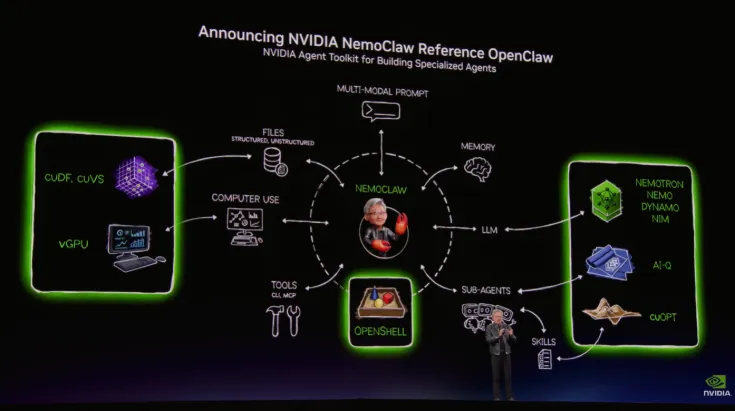
These agents can interact with cloud platforms, coordinate with other agents and break down complex problems into smaller tasks. To support enterprise adoption, NVIDIA also introduced tools designed to improve security and manage how these agents interact with external systems.
Supporting this ecosystem is the continued development of the Nemotron model family. NVIDIA is collaborating with partners across the AI ecosystem to expand these models and enable organisations to build powerful reasoning systems for enterprise applications.
The result is a shift from simple AI assistants toward systems capable of executing multi step workflows autonomously.
AI moves into the physical world
The final portion of the keynote focused on what NVIDIA describes as physical AI. These are systems that perceive, reason and act in the real world.
During the event, NVIDIA demonstrated more than one hundred robots powered by its AI platforms. The company also highlighted new partnerships across the automotive industry, including collaborations with BYD, Hyundai Motor Company and Nissan Motor Corporation to accelerate the development of autonomous vehicles.
Ride hailing platforms are also exploring how these technologies could shape future transport networks. NVIDIA confirmed that it is working with Uber Technologies to integrate autonomous vehicles into ride sharing platforms in selected cities.
These developments highlight how AI is expanding beyond digital applications into robotics, automation and real-world systems.
A platform shift in computing
Taken together, the announcements from this year’s keynote highlight how rapidly the AI landscape is evolving.
Accelerated computing has moved from a niche technology used by researchers into a foundational layer of global infrastructure. From AI factories and agentic systems to robotics and digital simulation, organisations across every industry are exploring how these technologies can transform their operations.
For those building AI infrastructure today, the pace of innovation continues to accelerate. Platforms such as Rubin, combined with NVIDIA’s expanding software ecosystem, are shaping how the next generation of AI systems will be deployed.
As the AI era moves from experimentation into production, the technologies showcased at this year’s NVIDIA GTC provide a clear indication of where the industry is heading next.