As organisations accelerate their adoption of AI, many are running into a familiar challenge: the infrastructure they already have was never designed for today’s large-scale inference workloads, retrieval-augmented generation (RAG) pipelines or emerging agentic AI systems.
Cloud platforms can bridge the gap quickly, but they often introduce long-term cost unpredictability and data governance concerns. On the other hand, building out dedicated GPU-dense infrastructure can require significant redesigns across power, cooling and rack architecture.
There is a third path emerging for enterprises that want performance without disruption. With AMD Instinct™ MI350P PCIe GPUs available through Boston Limited, organisations can introduce leadership AI capability directly into their existing data centre environments without starting from scratch.
Even better, these systems can be evaluated, tested and validated in Boston Labs before deployment, helping teams move from concept to production with confidence.
A gpu designed to fit the data centre you already have
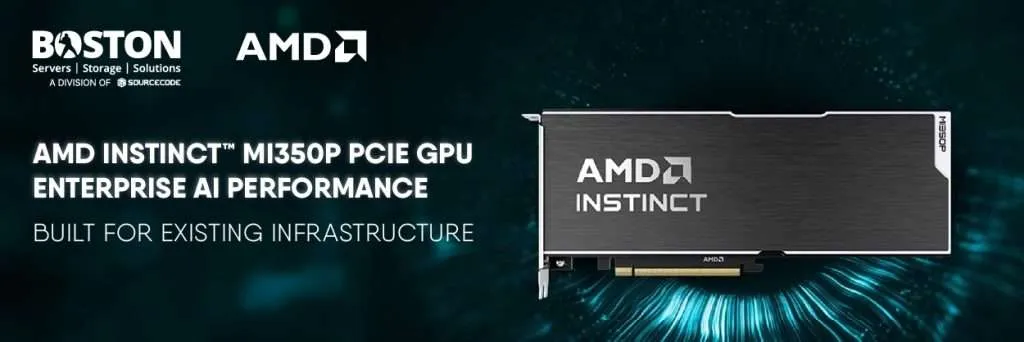
The AMD Instinct MI350P PCIe accelerator is designed for a practical reality many enterprises face: the need for high-performance AI compute inside standard air-cooled servers.
Rather than requiring specialised chassis or hyperscale redesigns, these dual-slot PCIe cards are built to slot into existing infrastructure. That means organisations can expand AI capability within their current racks, power envelopes and cooling constraints.
Designed as an air-cooled solution, the AMD Instinct MI350P PCIe GPU simplifies deployment for organisations looking to introduce AI acceleration without extensive changes to existing thermal or rack infrastructure.
This makes them particularly well suited for enterprises that are:
- Expanding on-prem AI inference capacity
- Moving workloads away from cloud-based GPU instances
- Building internal RAG pipelines and private AI services
- Looking to improve performance beyond CPU-only systems without a full infrastructure overhaul
Depending on configuration, servers can support multiple AMD Instinct MI350P GPUs, enabling scalable AI compute density while still operating within conventional data centre designs.
Performance that focuses on real-world ai workloads
The AMD Instinct MI350P PCIe platform is engineered for high-throughput AI inference, prioritising both performance and efficiency across modern model types.
At its core, the architecture is designed to accelerate workloads used in production AI environments today, including small to large language models, recommendation systems and retrieval-augmented generation workflows.
The platform is capable of handling the Hugging Face OPT Transformer large language model with 130 billion parameters on a single GPU using an FP16 dataset, helping organisations consolidate demanding AI workloads within a more compact infrastructure footprint.
Key architectural advantages include:
- Support for low-precision formats such as MXFP6 and MXFP4 to maximise throughput
- Efficient acceleration of commonly used precisions including INT8 and BF16
- Sparse computation support to improve performance across mixed workloads
- High-bandwidth memory design using up to 144GB HBM3E with bandwidth reaching up to 4TB/s (estimated)
- Delivers up to 4,600 peak TFLOPs utilising MXFP4 and up to 2,299 TFLOPs for FP16 operations
Rather than focusing purely on theoretical compute, the MI350P PCIe design is aimed at delivering consistent performance for enterprise inference workloads where cost per token, latency and throughput matter most.
scaling ai without rebuilding infrastructure
One of the key advantages of the PCIe form factor is deployment simplicity. These GPUs are designed to integrate into standard server architectures, making them an attractive option for organisations that want to scale AI gradually rather than committing to a full platform redesign.
In practice, this means enterprises can:
- Introduce GPU acceleration into existing CPU-based servers
- Scale from pilot projects to production deployments in stages
- Avoid major changes to cooling or power distribution systems
- Deploy AI closer to data sources for lower latency use cases
For many organisations, this approach reduces both technical friction and operational risk. It allows AI adoption to align with existing infrastructure investment cycles rather than forcing immediate capital-intensive upgrades.
open ecosystem and software flexibility
AMD continues to support an open software approach, and the MI350P PCIe ecosystem reflects that strategy. Instead of locking customers into proprietary stacks, AMD provides compatibility with widely used frameworks and orchestration tools.
The AMD Instinct MI350P PCIe GPU runs on the open-source AMD ROCm™ enterprise software stack, enabling organisations to build and scale AI environments with greater flexibility, transparency and interoperability.
This includes support for:
- Kubernetes-based GPU management for lifecycle orchestration
- PyTorch and other mainstream AI frameworks
- AMD Inference Microservices for cloud-native deployment models
- Open-source tooling designed to reduce dependency on proprietary licensing models
For enterprises, this openness translates into flexibility. Teams can integrate AMD Instinct GPUs into existing AI workflows with minimal code changes while maintaining control over their software stack and deployment strategy.
precision where it matters in enterprise ai
Modern AI workloads rely on a range of numerical precision formats depending on performance and accuracy requirements. The AMD Instinct MI350P PCIe platform is designed to handle this spectrum efficiently.
Lower-precision formats such as MXFP4 and MXFP6 are particularly effective for maximising throughput in inference-heavy workloads. Meanwhile, higher-precision formats like INT8 and BF16 benefit from architectural optimisations such as sparsity support, helping maintain efficiency even when accuracy requirements increase.
This flexibility allows organisations to:
- Optimise performance per workload type
- Balance accuracy and efficiency dynamically
- Reduce memory pressure across large model deployments
- Improve energy efficiency within existing air-cooled environments
The result is a GPU platform that can adapt to mixed enterprise AI demands rather than requiring separate infrastructure for different precision levels.
validating amd instinct mi350p in boston labs
Hardware capability is only part of the equation. The real challenge for many organisations is understanding how new AI infrastructure will behave within their own workloads, datasets and operational constraints.
This is where Boston Limited adds value.
Through Boston Labs, customers can test AMD Instinct MI350P PCIe solutions in a controlled environment before committing to deployment. This enables teams to:
- Benchmark inference performance using real application workloads
- Validate integration with existing AI software stacks
- Test scaling across multiple GPU configurations
- Assess power, thermal and rack compatibility assumptions
- Optimise deployment strategy before production rollout
By combining AMD’s GPU architecture with Boston’s hands-on validation environment, organisations can reduce uncertainty and make more informed infrastructure decisions.
moving from ai experimentation to production deployment
AI adoption is no longer just about experimentation. Enterprises are now focused on operationalising AI at scale, delivering consistent performance while controlling cost and maintaining data governance.
The AMD Instinct MI350P PCIe platform provides a pathway to do exactly that within existing infrastructure constraints. When delivered through Boston Limited, it becomes part of a broader solution that includes configuration support, integration expertise and real-world validation in Boston Labs.
Rather than forcing organisations into cloud dependency or expensive infrastructure redesigns, this approach allows AI to be deployed where data already lives.
To explore AMD Instinct MI350P PCIe solutions or to arrange testing in Boston Labs, speak with the Boston Limited team on 01727 876100 to understand how your existing infrastructure can support the next stage of your AI strategy.