
Introduction
At Boston, we’re always keen to explore the latest advancements in high-performance computing and AI infrastructure. The NVIDIA DGX B300 is a significant addition to this space, combining the Blackwell Ultra architecture with high-bandwidth networking, extensive GPU memory and the infrastructure needed to support demanding AI workloads.
In this article, we take a closer look at the DGX B300, from its internal architecture and processing capabilities to its memory, networking, storage, cooling and overall design, giving an insight into what it takes to deliver this level of AI performance in a data-centre environment.
Blackwell Ultra Architecture
The DGX B300 is built around eight NVIDIA Blackwell Ultra SXM GPUs. Each GPU provides 288 GB of GPU memory, giving the system approximately 2.3 TB of GPU memory in total.
This substantial memory capacity is particularly important for modern AI workloads, where increasingly large models and datasets need to remain close to the compute resources. Rather than relying extensively on slower external memory or storage, large amounts of high-bandwidth GPU memory allow workloads to keep more of their working data immediately available to the accelerators.
NVIDIA specifies up to 144 PFLOPS of FP4 Tensor Core performance for the DGX B300, alongside 72 PFLOPS of FP8 Tensor Core performance. NVIDIA also reports that DGX B300 delivers 1.5× the dense FP4 performance and 2× the attention performance of DGX B200.
The result is a platform aimed not simply at training larger models, but at handling increasingly sophisticated inference and reasoning workloads where throughput, latency and memory capacity are all critical.
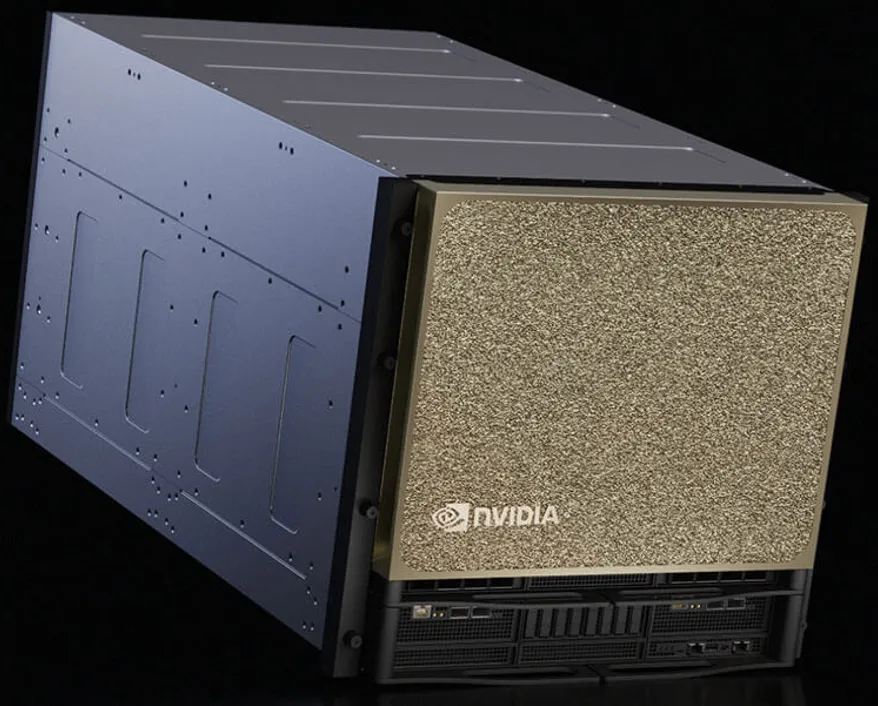
The NVIDIA DGX B300
System Specification
The table below highlights the key specifications and technical capabilities of the NVIDIA DGX B300.
| GPU | 8x NVIDIA Blackwell Ultra SXM |
| Total GPU Memory | 2.1 TB total, 62 TB/s HBM3e bandwidth |
| Performance | FP4 Tensor Core* – 144 PFLOPS | 108 PFLOPS |
| FP8/FP6 Tensor Core** – 72 PFLOPS | |
| System Memory | 2 TB, configurable to 4 TB |
| NVIDIA NVLink™ Switch System | 2x |
| NVIDIA NVLink Bandwidth | 14.4 TB/s aggregate bandwidth |
| System Power | 14.5 kW (Busbar) |
| 15.1 kW (PSU) | |
| CPU | Intel Xeon 6776P processors |
| Networking | 8x OSFP ports serving 8x NVIDIA ConnectX-8 VPI >Up to 800 Gb/s of NVIDIA InfiniBand/Ethernet |
| 2x dual-port QSFP112 NVIDIA BlueField®-3 DPU >Up to 400 Gb/s of NVIDIA InfiniBand/Ethernet | |
| Management Network | 1GbE onboard network interface card (NIC) with RJ45 |
| 1GbE RJ45 host baseboard management controller (BMC) | |
| Storage | OS: 2x 1.9 TB NVMe M.2 |
| Internal storage: 8x 3.84 TB NVMe E1.S | |
| Software | NVIDIA AI Enterprise (optimised AI software) |
| NVIDIA Mission Control (AI data center operations and orchestration with NVIDIA Run:ai technology) | |
| NVIDIA DGX OS (operating system) | |
| Supports Red Hat Enterprise Linux / Rocky / Ubuntu | |
| Rack Units | 10 |
| Operating Temperature | 10C°–35C° |
| Support | Three-year business-standard hardware and software support |
* Specification shown as sparse | dense.
** Shown with sparsity. Dense is 1/2 sparse spec shown.
Link to data table: https://resources.nvidia.com/en-us-dgx-systems/dgx-b300-datasheet
The Packaging
The DGX B300’s outer packaging features robust cardboard edges to help protect the main box and its contents during transit.
Inside, the packaging is split into two sections. The upper section contains the accessory box with the power cables other supplied accessories, and the trademark golden front bezel, all protected with foam. The lower section houses the DGX B300 itself, secured in protective foam and enclosed in an antistatic bag to protect against shocks, movement and electrostatic discharge during transportation.
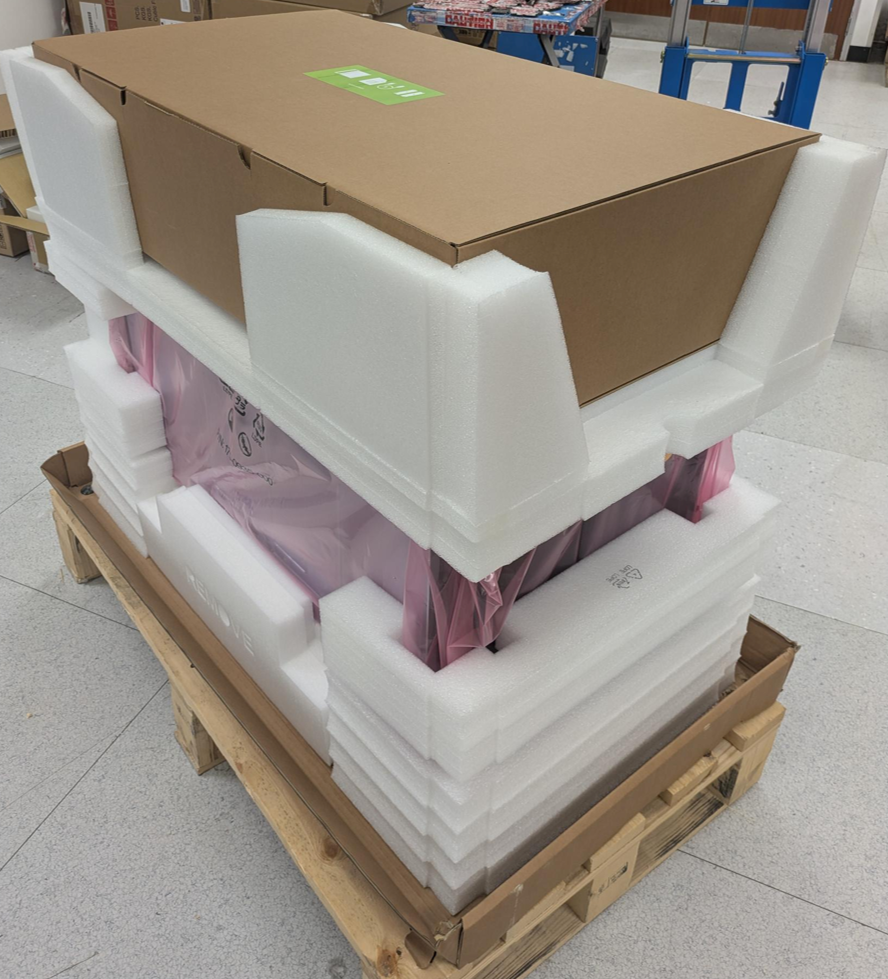
Unboxing the main packaging with two-tier secure stacking
The Outside
The DGX B300 chassis is a substantial 10U rack-mounted system, reflecting the amount of compute and supporting hardware packed inside. Measuring approximately 442 × 482.6 × 904.2 mm, the chassis has a dense, purpose-built design that houses eight NVIDIA Blackwell Ultra GPUs alongside the host processors, high-speed networking, storage and power infrastructure.
From the outside, the front of the chassis is dominated by the cooling and service infrastructure, with airflow carefully managed to support the system’s high thermal load. The chassis also incorporates a range of serviceable components, with NVIDIA designing the system so that key cooling and hardware components can be accessed without completely dismantling the platform.
The DGX B300 is considerably heavier than a conventional enterprise server. This weight, combined with its 10U form factor and substantial depth, gives the chassis an imposing physical presence. It is very much a data-centre appliance designed around maximum AI compute density, rather than a traditional general-purpose server.
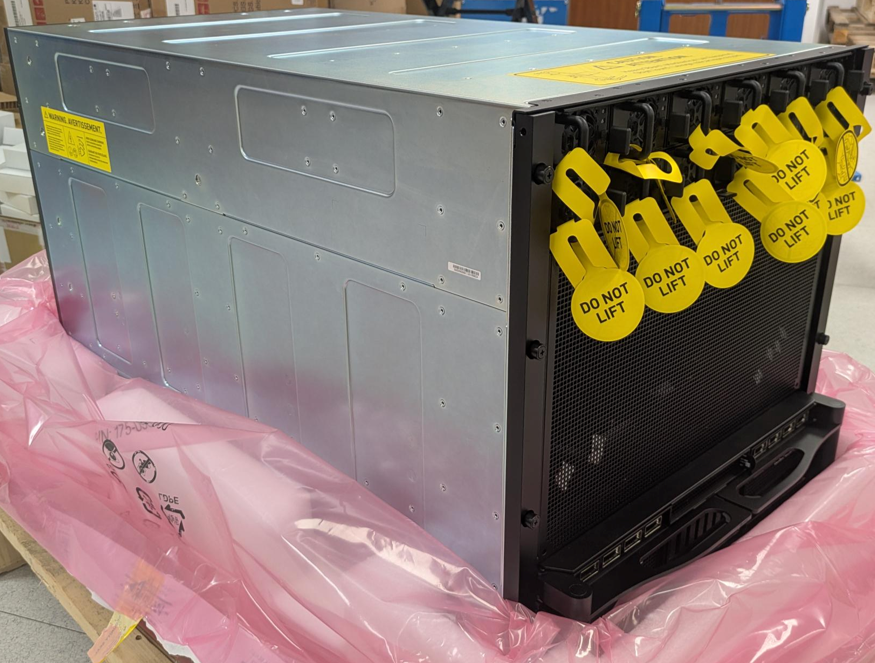
The exterior of the B300
Networking
A system with eight high-end GPUs needs an equally capable network architecture. The DGX B300 therefore includes 2 x NVIDIA ConnectX-8 network cards which provide eight interfaces[TM2] [PW3] . These ports can provide up to 800 Gb/s for InfiniBand or Ethernet.
The system also includes two dual-port NVIDIA BlueField-3 DPUs, providing up to 400 Gb/s InfiniBand or Ethernet connectivity.
This gives the DGX B300 the networking capability required to scale beyond a single server.
In larger AI clusters, individual systems are combined into high-performance computing fabrics where GPU-to-GPU communication can extend across multiple nodes. High-speed InfiniBand and Ethernet therefore become a fundamental part of AI performance rather than simply a method of connecting servers together.
For system administration and out-of-band management, the DGX B300 includes a 1GbE onboard network interface with an RJ45 connector, alongside a dedicated 1GbE RJ45 connection for the host Baseboard Management Controller (BMC). This management network provides a separate path for monitoring, configuration and remote hardware management, allowing administrators to manage the system independently of the high-speed data-network interfaces used by AI workloads.
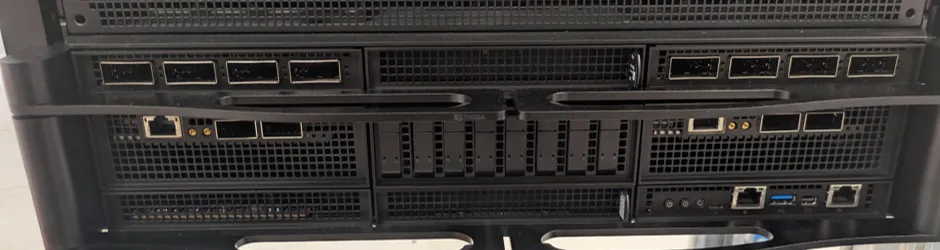
DGX B300 front focusing on the networking, I/O ports and NVMe drives
Storage
The DGX B300 includes both boot storage and high-capacity internal NVMe storage.
For the operating system, there are two 1.92 TB M.2 NVMe drives. Internal storage is provided by eight 3.84 TB E1.S NVMe drives, providing a substantial local storage pool for datasets, checkpoints and other high-performance workloads.
The use of E1.S drives is particularly suited to dense modern server platforms, providing high-performance storage while allowing the physical infrastructure to remain compact.
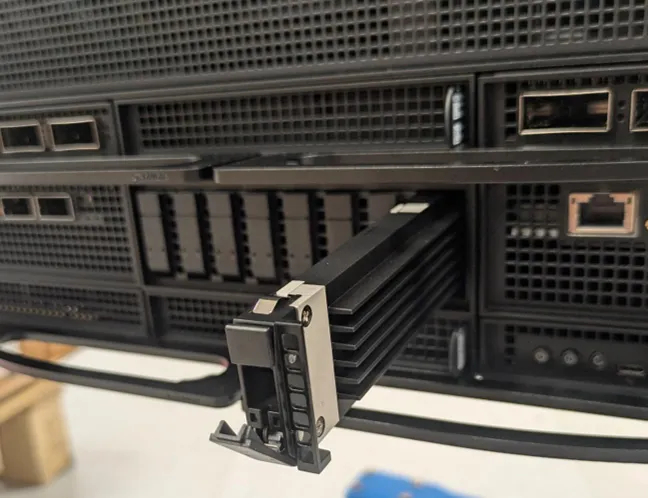
E1.S drives
The Inside
SXM B300s
At the heart of the DGX B300 are eight Blackwell Ultra GPUs connected through NVIDIA’s fifth-generation NVLink technology and two NVLink switch systems.
This high-speed interconnect is essential because the eight GPUs need to operate as a tightly coupled compute platform. Instead of treating each accelerator as an isolated device, NVLink allows data to move between GPUs at extremely high bandwidth, helping distributed AI workloads scale across the complete system.
The DGX B300 provides an aggregate NVLink bandwidth of up to 14.4 TB/s.
For AI applications, this is particularly important when models are too large to fit comfortably onto a single GPU or when workloads need to distribute computation across multiple accelerators.
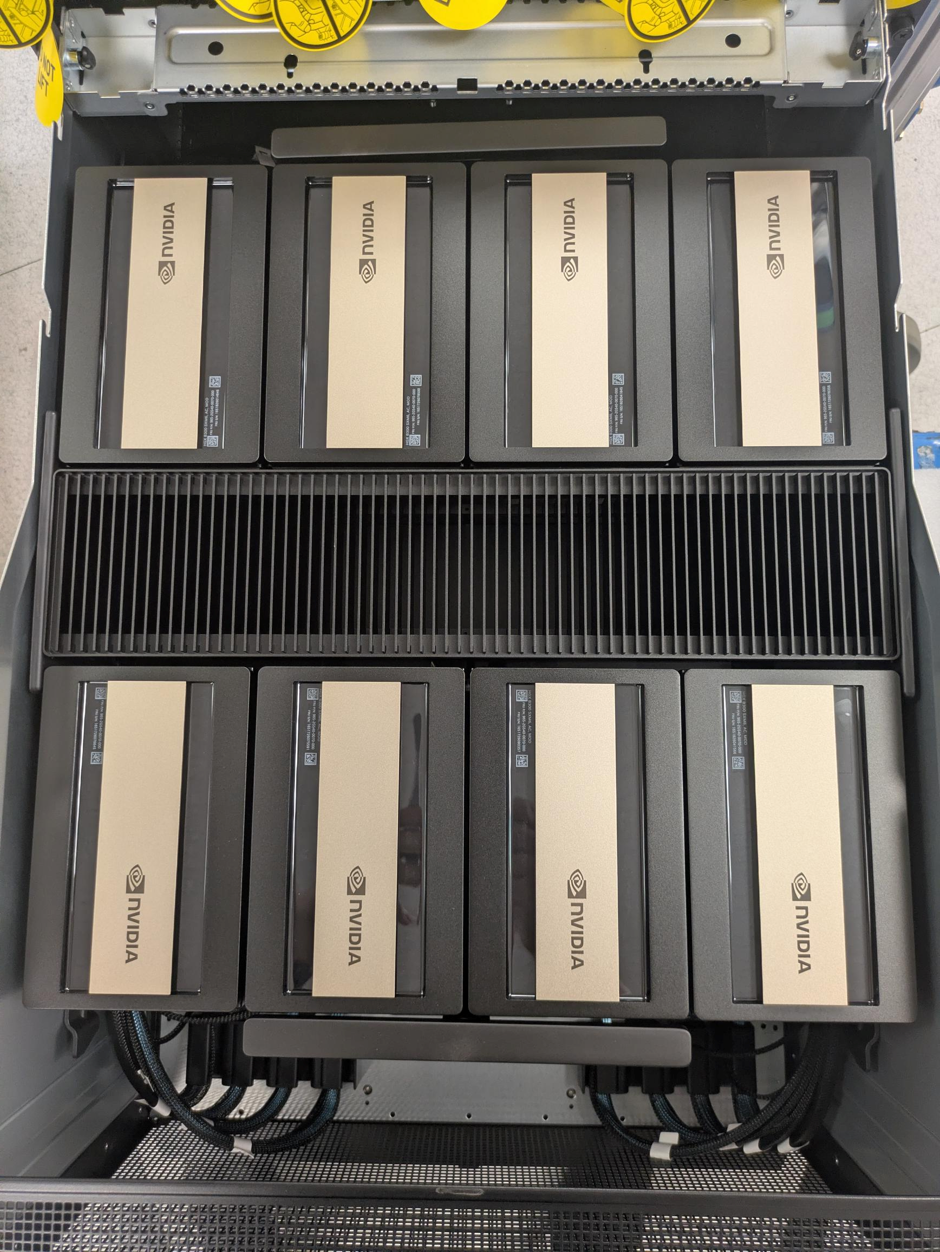
The 8 x SXM B300 GPUs from the top
The Processors
While the GPUs provide the majority of the accelerated compute, the host platform is powered by two Intel Xeon Platinum 6776P processors.
The DGX B300 supports up to 2 TB of system memory as standard, with configurations supporting up to 4 TB. This gives the host CPUs substantial memory capacity for data preparation, orchestration, operating-system functions and workloads that complement GPU acceleration.
The combination of Intel Xeon CPUs and Blackwell Ultra GPUs creates a heterogeneous compute platform, with each part of the system performing the tasks for which it is best suited.
Memory
Memory is one of the defining characteristics of modern AI infrastructure, and the DGX B300 is designed accordingly.
The system provides eight Blackwell Ultra GPUs with 288 GB of GPU memory each, for a total of 2.3 TB. In addition, the system can be configured with up to 4 TB of host system memory.
This combination gives the DGX B300 a large pool of high-speed accelerator memory backed by substantial CPU-side memory capacity.
For large language models, generative AI and reasoning workloads, memory capacity can be just as important as raw compute performance. Keeping model weights, activations and frequently accessed data close to the accelerators helps reduce data movement and allows the available compute resources to remain productive.
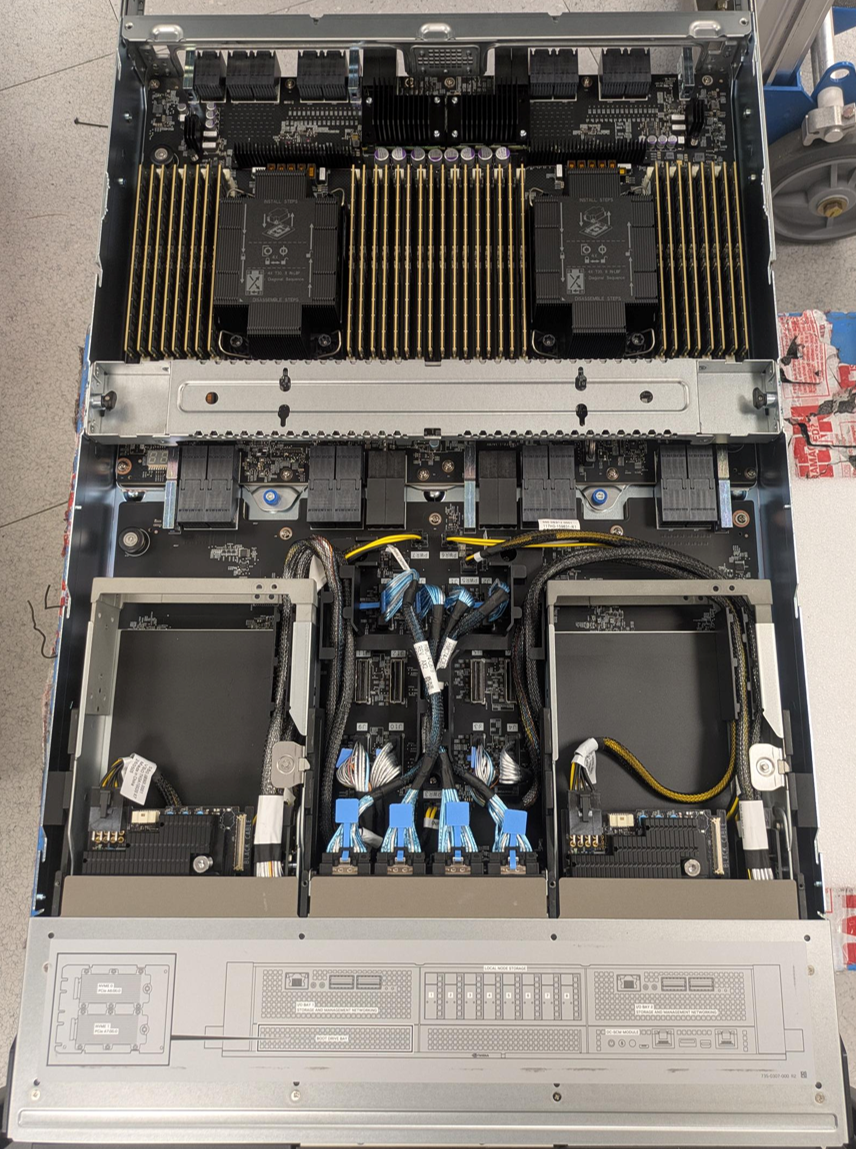
Everything else in the bottom tray
Power and Cooling
The performance of eight Blackwell Ultra GPUs comes with substantial infrastructure requirements.
NVIDIA estimates system power at approximately 14.5 kW for the DC/busbar version and 15 kW for the AC/PDU configuration, with estimated peak system power approaching 20 kW.
The system can use an active rear-door heat exchanger in a liquid-assisted configuration, while the AC version can use air cooling. NVIDIA specifies an operating temperature range of 10°C to 35°C.
The chassis uses a series of modular fan assemblies to maintain airflow through the system, with the fans monitored by the onboard BMC for speed and health. Each fan module contains two fans, and the modules are designed to be replaceable for servicing, helping minimise downtime in a data-centre environment.
For data-centre operators, planning for the DGX B300 therefore means looking beyond the server itself and considering power distribution, cooling capacity, rack design and the supporting network infrastructure.
The system is available in both AC/PDU and DC/busbar configurations, giving data-centre operators flexibility in how the platform is integrated into their existing infrastructure.
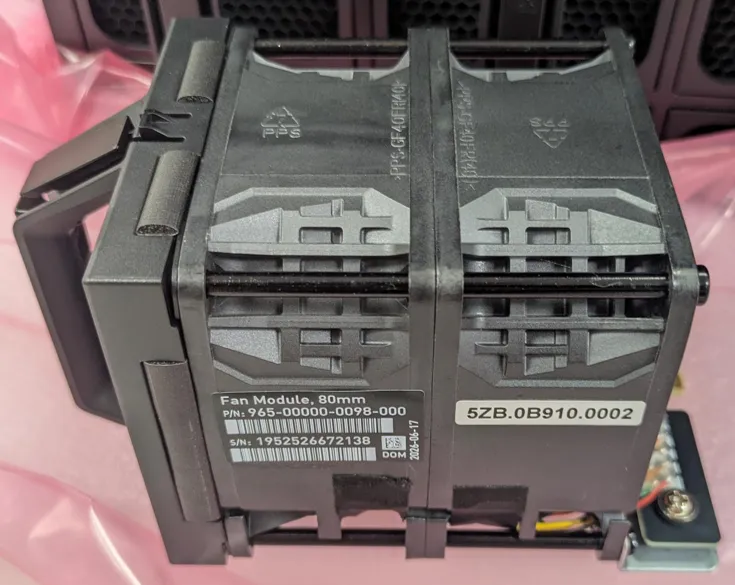
Modular Fans
Software and Licensing
The DGX B300 comes with a comprehensive NVIDIA software stack designed to provide a ready-to-deploy AI platform. The standard software offering includes NVIDIA AI Enterprise, providing optimised software for AI development and deployment; NVIDIA Mission Control, providing AI data-centre operations and orchestration with NVIDIA Run technology; and NVIDIA DGX OS, NVIDIA’s optimised operating system for DGX systems.
The pre-installed DGX OS environment also incorporates a range of NVIDIA tools and components to help manage, monitor and optimise the system. This includes NVIDIA System Management (NVSM) and Data Center GPU Manager (DCGM) for system and GPU monitoring, alongside the NVIDIA GPU driver and CUDA software required to run accelerated applications. The platform also includes Docker Engine and NVIDIA Container Toolkit, making it easier to deploy containerised AI workloads, while DOCA-OFED and NVIDIA Networking Software Tools provide the software support required to manage and utilise the system’s high-speed networking infrastructure. Together, these components provide the core software foundation needed to configure, monitor and operate the DGX B300 as a complete AI platform.
Conclusion
The NVIDIA DGX B300 represents a substantial evolution of the DGX platform.
With eight Blackwell Ultra GPUs, around 2.3 TB of GPU memory, up to 144 PFLOPS of FP4 Tensor Core performance, 14.4 TB/s of aggregate NVLink bandwidth and up to 800 Gb/s networking, it is designed for AI workloads that are simply beyond the capabilities of conventional enterprise servers.
However, the headline performance is only part of the story. At around 15 kW of estimated system power, 10U of rack space and with advanced cooling requirements, deploying DGX B300 requires careful consideration of the wider data-centre environment.
For organisations looking to build serious AI infrastructure, this is precisely where the DGX B300 becomes interesting. It combines NVIDIA’s latest accelerator technology with the networking, storage, management and software capabilities required to turn that compute into a deployable enterprise AI platform.
The next generation of AI infrastructure is not simply about putting faster GPUs into a server. It is about building an entire system around them—and the DGX B300 is a strong example of what that approach looks like.
If you are ready to start your NVIDIA DGX B300 journey, then please get in touch either by email or by calling us on 01727 876100 and one of our experienced sales engineers will happily guide you to your perfect tailored solution and invite you for a demo.