Overview of AMD Helios
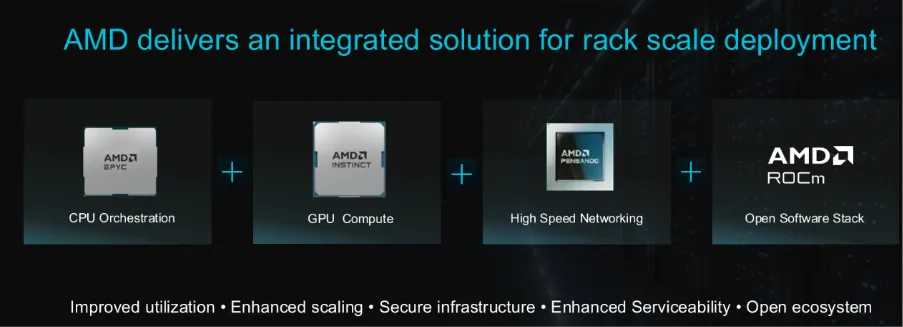
AMD Helios moves beyond the constraints of a conventional 19-inch server rack with a double-wide Open Rack Wide (ORW) design purpose-built for high-density, rack-scale AI infrastructure. The larger system design enables 72 AMD Instinct MI455X GPUs, 6th Gen AMD EPYC “Venice” CPUs, AMD Pensando networking, scale-up switching, power infrastructure and liquid cooling to be integrated as a coordinated system. This rack-level approach supports the power, cooling, connectivity and serviceability requirements of next-generation AI systems while reducing integration complexity. As a reference architecture rather than a fixed appliance, Helios also gives OEM and ODM partners (like Supermicro) a common foundation for developing differentiated, production-ready AI platforms.
System Architecture Highlights
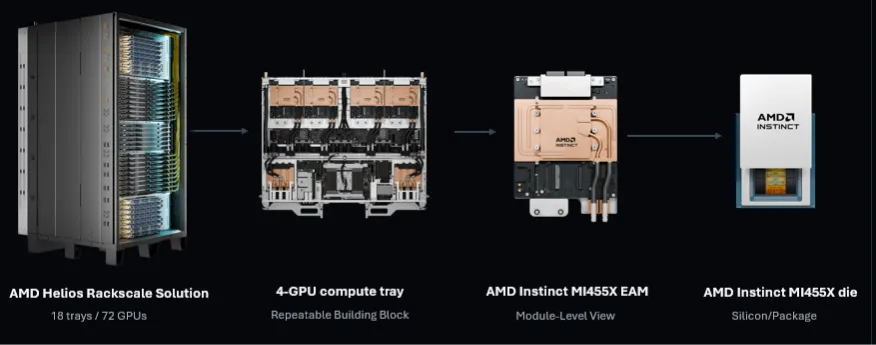
AMD Instinct™ MI455X GPUs, built on the AMD CDNA™ architecture, combine massive HBM4 capacity, extreme memory bandwidth and multi-petaflop compute performance to accelerate large-scale inference and AI training across the Helios rack-scale platform. MI455X GPUs enable efficient scaling for large models and high-throughput AI infrastructure deployments.
6th Gen AMD EPYC™ CPUs deliver high core counts, fast CPU-to-GPU connectivity and high-bandwidth memory access to support AI orchestration, training and inference workloads at rack scale. Optimised for modern AI infrastructure, EPYC processors help orchestrate networking, storage and workloads at rack scale.
AMD Pensando™ “Vulcano” 800 AI NIC delivers leadership performance with 800 Gbps Ethernet speeds and is the only AI NIC to offer up to 2.4 Tbps of scale-out bandwidth per GPU, with full hardware and software programmability to keep GPUs and CPUs continuously fed at rack scale. The Scale-Up Fabric built on an open networking approach, leverages UALink over Ethernet (UALoE) to deliver high bandwidth, low-latency GPU connectivity at rack scale. Powered by advanced Ethernet silicon, it enables seamless interconnect up to 72 GPUs per Helios rack, supporting efficient scaling and reduced vendor lock-in.
The Deployment of AMD Helios
Inside one rack
Fast scale-up with UALink™ over Ethernet connects all 72 AMD Instinct™ MI455X GPUs within a single Helios rack, creating one high-speed 72-GPU pod. UALoE enables the GPUs to operate together as a unified, low-latency in-rack domain, providing high-bandwidth GPU-to-GPU connectivity. Designed for at-scale AI inference and training, the architecture maximises accelerator performance, improves communication efficiency and supports demanding, large-scale AI workloads within one integrated rack-scale system.

Across Many Racks
Open Ethernet connects multiple AMD Helios racks into larger, high-performance AI clusters, enabling scalable distributed inference and training across racks. This open architecture delivers flexible, interoperable cluster scale-out while avoiding proprietary networking fabrics and supporting increasingly demanding AI workloads. Together, these building blocks form a single open, rack-scale system that drives industry-leading performance, seamless scale from rack to cluster, greater efficiency and serviceability, open standards at every layer and a production-ready open software foundation for hyperscale and sovereign AI.
ACHIEVE INDUSTRY-LEADING AI PERFORMANCE
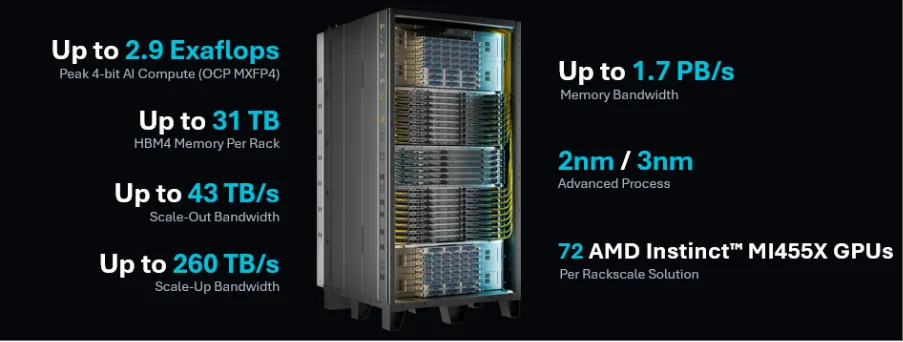
Powered by 5th Gen AMD CDNA™ architecture, AMD Instinct™ MI455X GPUs deliver up to 2.9 exaFLOPS of OCP MXFP4 performance and 260 TB/s scale-up bandwidth per rack, with up to 31 TB HBM4 memory, 1.67 PB/s memory bandwidth and 43 TB/s aggregate scale-out bandwidth. MI455X delivers more than 4x the peak theoretical low-precision performance and up to 2.91x the memory bandwidth of MI355X. Compared with NVIDIA Vera Rubin, MI455X provides up to 26% higher peak FP16/BF16 matrix performance, 15% higher peak low-precision performance across key datatypes and 50% greater memory capacity for large-scale AI workloads.
IMPROVE EFFICIENCY AND SERVICEABILITY
AMD Instinct MI455X GPUs combine high bandwidth and up to 2500W TBP in a liquid-cooled EAM form factor to deliver efficient, high-performance AI inference and training. AMD Helios supports flexible shared and multi-tenant deployments through Virtual Pod partitioning from 4 to 72 GPUs, GPU-level compute partitioning and NUMA-based spatial memory isolation, with compute nodes able to span non-adjacent locations within the rack. Rack-scale power and cooling optimisation further improves operational efficiency and scalability across hyperscale and sovereign AI environments. Looking ahead, AMD targets a 20x improvement in rack-scale energy efficiency by 2030 versus a 2024 baseline, potentially enabling workloads that currently require more than 275 racks to run in fewer than one fully utilised rack while using 95% less electricity.
DEPLOY WITH A PRODUCTION-READY OPEN SOFTWARE STACK
AMD ROCm software transforms Helios into deployable, scalable AI infrastructure for inference, training and fine-tuning from rack to cluster, while supporting open frameworks and interoperable networking for flexibility and consistent performance. Day-0 support spans major AI frameworks and runtimes including PyTorch, JAX, vLLM, SGLang, ONNX Runtime and TensorFlow as well as leading open models such as DeepSeek. At exaFLOP-class scale, ROCm enables predictable distributed execution through RCCL communication primitives, KV-cache optimisations and optimised compute/communication overlap. AMD AI Academy and the AMD Developer Cloud further expand developer access, strengthen ecosystem partnerships and accelerate AI innovation.
Summary
AMD is accelerating AI infrastructure development with unmatched momentum, adopting open standards and deepening its presence across a broad network of hardware and software collaborators. AMD Helios, powered by AMD Instinct™ MI455X GPUs, is the result of a complete, open, rack-scale AI infrastructure platform purpose-built for hyperscale and sovereign AI deployments.
Boston with AMD
Boston and AMD have a long-standing technology partnership focused on delivering high-performance computing, AI and data centre infrastructure. Boston combines AMD EPYC processors and AMD Instinct accelerators with its expertise in system design, integration, deployment and support to deliver scalable solutions for AI, HPC, cloud and enterprise workloads. The partnership enables customers to benefit from AMD’s latest compute technologies through flexible, purpose-built infrastructure designed to meet a wide range of performance and deployment requirements.